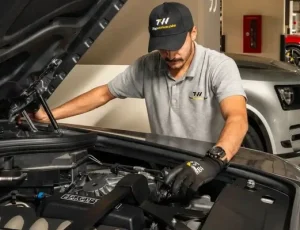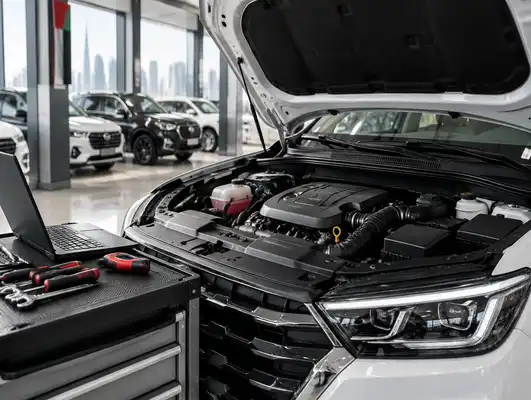
The Day I Opened a Brand-New Bonnet and Found a Surprise
A client in Dubai Marina called us last year.
He had just collected his new SUV from the showroom. Pristine colour. That new-car smell. A full factory warranty. He was thrilled.
But something felt off when he drove it home. A faint shimmy at 100 km/h. A tiny creak from the front left when he turned.
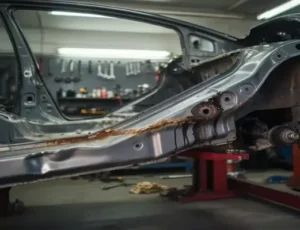
When we lifted it on the ramp, we found something that shouldn’t exist on a car with 37 kilometres on the clock — paint overspray on the front bumper and a fresh repair to the lower quarter panel.
The car had been repaired before delivery. Nobody told him.
This is not rare. In over 10,000 inspections across the UAE, our team has seen this situation more times than we can count. And it doesn’t only happen with used cars.
It happens with brand-new ones too.
Why “Brand New” Doesn’t Always Mean “Perfect”
When you buy a new car in the UAE, you assume you’re getting a vehicle in flawless factory condition. Most of the time, you are.
But the journey a car takes from the factory to your hands is longer than most people realise.
It travels by sea. It spends weeks — sometimes months — in a port stockyard. It gets loaded and unloaded, driven onto transporter trucks, parked in outdoor lots under the UAE sun. In some cases, it arrives with minor damage that gets quietly repaired before it reaches the showroom floor.
None of this makes the car fundamentally bad. But “new” is not the same as “inspected.”
The Five Hidden Risks
1. Pre-Delivery Repairs You Were Never Told About
New cars can be damaged in transit — a scratch during loading, a door ding in the stockyard, a minor bumper impact at the port.
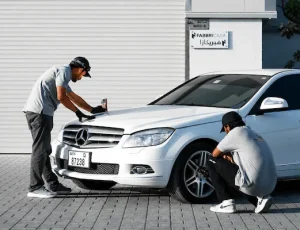
Many of these repairs are done professionally and are invisible to the naked eye. But a paint thickness gauge tells a different story. If a panel reads significantly thicker than its neighbours, it has been repainted.
Some buyers have walked into this unaware. Others have caught it first — a new car inspection before accepting delivery is the fastest way to know. We go deeper on exactly how to detect this in our breakdown of cars repaired before delivery.
2. How Long the Car Has Been Sitting — and Why It Matters
New cars often sit in open stockyards for weeks or months — exposed to extreme UAE heat, coastal humidity, and UV radiation.
A car that’s been sitting in a stockyard for six months will have a battery under more stress than one that arrived last week. Its brake fluid may have absorbed moisture. Its tyres may have developed flat spots.
The model year on the badge tells you nothing about how long that specific unit has been sitting.
3. The Odometer Reading at Delivery
When you collect a new car, it will already have some kilometres on it. That’s normal — factory testing, PDI, showroom movements all add up.
A reasonable delivery reading for most cars in the UAE sits between 10 and 50 kilometres.
But what if it shows 200? Or 400? Those kilometres didn’t appear by magic. You have every right to ask — and to know what the odometer at delivery actually tells you before you sign.
4. The Tyre Manufacturing Date vs the Car’s Model Year
Your new car might be a 2025 model. The tyres fitted to it could have been manufactured in 2022.
Tyre age matters here more than almost anywhere else. UAE heat accelerates rubber degradation faster than temperate climates. A tyre that’s been sitting for two or three years before it ever goes on your car has less remaining service life than the tread depth suggests.
The tyre manufacturing date is stamped into every sidewall — a four-digit DOT code most buyers never check. Our tyre inspection covers this as standard.
5. How to Tell If Damage Happened at the Factory, in Storage, or in Transit
Not all damage is equal — and who caused it determines who’s responsible.
A manufacturing defect is the manufacturer’s problem. Transit damage is the importer’s. An undisclosed pre-delivery repair is the dealer’s. Knowing the difference protects your rights and your wallet. We break down how to tell defect from transit damage.
What a Professional New Car Inspection Catches
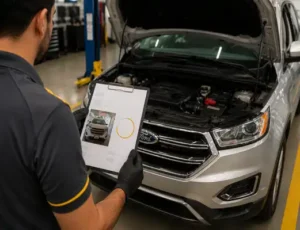
You might think: it’s a new car, why inspect it? Here’s what our inspectors regularly find on new deliveries:
- Paint overspray indicating panel repairs
- Scratches hidden under protective film
- Tyres two-plus years old at delivery
- Battery health compromised from storage
- High odometer readings with no explanation
- Seal leaks or alignment issues from transit
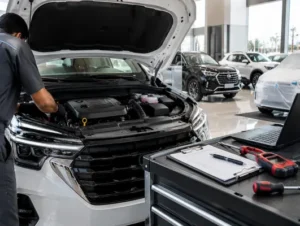
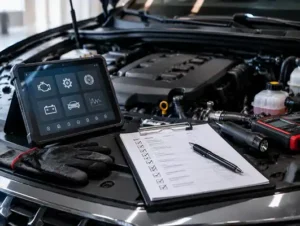
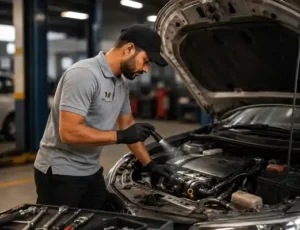
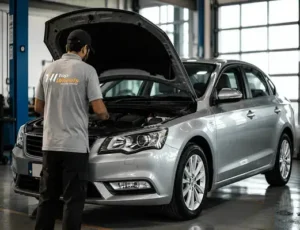
Our pre-purchase inspection in Dubai covers all of this. We come to the showroom, carry out the checks, and hand you a written report before you sign anything.
What to Do Before You Accept Delivery
A practical checklist from our inspectors:
Exterior
- Walk the full perimeter in natural daylight, not showroom lighting
- Look for any misaligned panel gaps or inconsistent trim
- Remove protective film from all areas and inspect underneath
Tyres
- Check all four DOT codes for manufacturing date
- Look for flat spots, cracking, or sidewall irregularities
Odometer
- Note the exact reading before the test drive
- Ask for an explanation if it’s over 100 km
Under the Bonnet
- Check fluid levels and look for any staining or leakage
- Inspect battery terminals for corrosion
Documentation
- Confirm the build date on the door-jam sticker
- Ask directly: has this vehicle undergone any pre-delivery repairs?
The Bottom Line
A brand-new car is one of the most significant purchases most people make.
The UAE’s car market is generally well-regulated and most dealers operate honestly. But the process is not foolproof — and the risks are real enough that knowing about them before you sign is always worth your time.
A car inspection in Dubai from Top Wheels Performance takes less than an hour. It costs a fraction of what a single undisclosed repair could cost you in resale value or warranty disputes.
We don’t just tell you the car is fine — we show you exactly what we found, with photos and a written report you can keep.