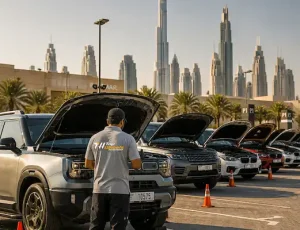
Last month I stood in a parking lot in Al Quoz next to a 2019 SUV that looked perfect. Clean paint. Low mileage on the cluster. Service stickers in the door jamb.
The buyer had already agreed a price on WhatsApp.
I asked the seller one question: “Did you start the car this morning?” He said yes, he’d warmed it up so it would be ready.
That single answer changed the whole inspection.
Here’s how I actually walk a car, in the order I do it, and what UAE conditions do to a vehicle that buyers almost never look for.
Before You Even Arrive: The Cold Start Rule
A warm engine hides almost everything.
Cold start noise, blue smoke on ignition, a rough idle, a slow crank from a dying battery — all of it disappears after ten minutes of running.
Tell the seller clearly: do not start the car before I get there. If he refuses, or if you arrive and the bonnet is already hot, that is information too.
I put my palm on the bonnet before I say hello. It’s the first test of the day.
Step 1: The Paperwork (5 Minutes That Can Save AED 30,000)
I do documents first, because if the papers are wrong, nothing under the bonnet matters.
Check the Mulkiya (registration card) against the car:
- Chassis number on the card must match the VIN plate on the car — usually on the dashboard base and the driver’s door pillar
- Owner name on the card should match the person selling it
- Look at the number of previous owners and the first registration date
Then check three things buyers forget:
- Outstanding finance. If the car is still mortgaged to a bank, ownership cannot transfer until the loan is cleared. Ask for a bank clearance letter, not a promise.
- Unpaid fines and Salik. These follow the vehicle at transfer time.
- Accident and insurance history. A car with a major structural claim will be worth noticeably less at resale, even if it drives fine today.
Also ask for the second key. A replacement smart key on a European or Japanese premium model can cost AED 1,500 to 3,000 with programming. That’s a real negotiating chip.
Step 2: Reading the Body Panels
I don’t look at a car head-on. I crouch at the corner and sight down the side in daylight.
Reflections lie less than paint does. Ripples in the reflection mean filler or a repaint.
What I check:
- Panel gaps. Bonnet, doors and boot should have even gaps left to right. A tight gap on one side and wide on the other points to a shunt.
- Bolt heads. Fender and bonnet bolts should have factory paint on them. Scratched or cracked paint on a bolt means the panel came off.
- Paint thickness. A gauge tells the truth instantly. Factory paint sits in a fairly consistent band across every panel. One door reading two or three times higher than the rest has been resprayed.
- Overspray. Look at rubber seals, in the door shuts, around the wheel arch lining.
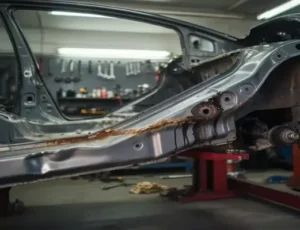
If the readings are inconsistent across a whole side of the car, I stop guessing and go straight to a proper car chassis inspection in Dubai — because panel damage that reaches the frame is a different conversation entirely.
Step 3: The UAE-Specific Damage Nobody Talks About
This is where cars in this country differ from cars anywhere else. Three things attack them: heat, sand, and water.
Heat
- Battery date sticker. In Dubai, batteries commonly last around 18 to 24 months, not four years. A battery older than two years is a purchase you’re about to inherit.
- Dashboard and door top cracks, brittle rubber seals, cloudy or yellowed headlight lenses.
- Clear coat peeling on the roof and bonnet — the two panels that take the most sun. It’s expensive to fix properly and it’s a strong sign the car lived outdoors.
Sand
- Sandblasting on the front bumper and a pitted windscreen. This is my favourite honesty test. A car showing 40,000 km on the cluster should not have a bumper that looks sandpapered and a windscreen full of tiny chips. That’s a highway car with a rolled-back odometer, and the sand told me before the paperwork did.
- Clogged radiator and condenser fins. Sand packs in behind the grille and quietly cooks the engine and AC.
- Air filter and cabin filter. If they’re black, the service history is decorative.
Water
The 2024 rains put a lot of flood-damaged cars back into circulation, and many were cleaned beautifully.
Pull the seatbelt all the way out to the stop. Look at the last 20 cm of webbing near the reel for a water line, silt, or staining. Detailers almost never clean that far in.
Then:
- Lift the boot floor and check the spare wheel well for rust or a tide mark
- Feel the carpet under the front seats — not the top, the underside
- Look at the seat rail bolts and seatbelt anchor bolts for surface rust
- Be suspicious of a strong air freshener in a car being sold
Flood cars don’t fail immediately. They fail six months later, in the wiring loom, one module at a time.
Step 4: Under the Bonnet
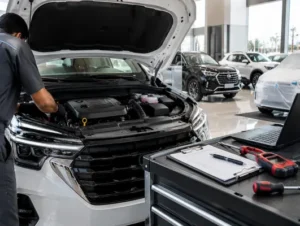
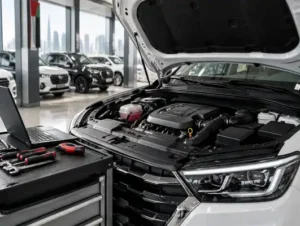
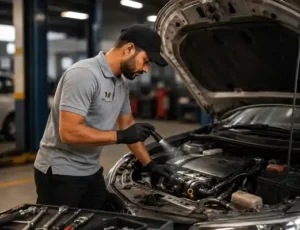
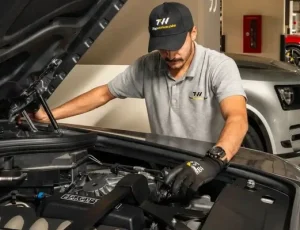
Cold engine, bonnet up, engine off first.
- Oil condition. Clean amber to light brown is fine. Gritty, thick, or a milky film on the cap is not.
- Coolant colour and level. Rusty brown coolant means a neglected system.
- Leaks. Look for wet residue where the engine meets the gearbox, around the oil pan, and along the power steering lines. Dubai dust sticks to fresh leaks and makes them easy to spot.
- Belts and hoses. Cracked serpentine belts are cheap; a snapped one on Sheikh Zayed Road is not.
- Signs of a very clean engine bay. A spotless bay on a seven-year-old car sometimes means a steam clean to hide a leak. I’d rather see honest dust.
Then start it cold and just listen for the first thirty seconds. Ticking that fades, a brief rattle, a puff of blue smoke — that’s the information the seller was trying to warm away.
Step 5: The Diagnostic Scan (And the Trick Most Buyers Miss)
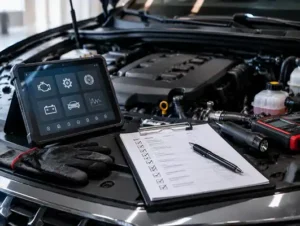
Plugging in an OBD scanner and seeing “no fault codes” makes buyers relax. It shouldn’t, on its own.
Codes can be cleared five minutes before you arrive.
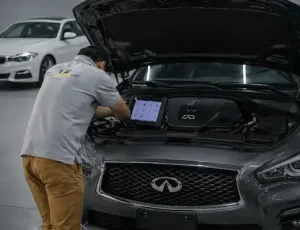
So I don’t only read codes — I read the readiness monitors. These are the self-tests the car’s ECU runs over normal driving: catalyst, oxygen sensor, EVAP and so on.
If several monitors show “not ready” on a car that’s clearly been driven, the memory was wiped recently. The dashboard is clean because someone made it clean, not because the car is healthy.
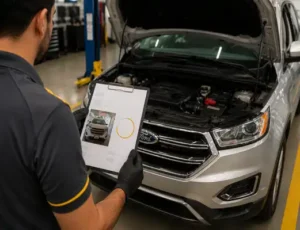
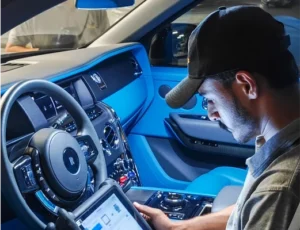
That one check has stopped more bad deals for me than any other single test. A full car electrical diagnostic in Dubai goes further, pulling stored and pending codes across engine, transmission, ABS, airbag and body modules.
Also confirm the airbag light actually illuminates on ignition and then goes out. A bulb that never comes on has usually been removed on purpose.
Step 6: Testing the AC the Right Way
Almost everyone tests the AC while driving. That’s the easy test.
Test it parked, in the sun, at idle, with the engine at operating temperature. That’s the condition that breaks air conditioning in this country: crawling on Al Ittihad Road in August.
- Air that’s cold at speed but warm at idle usually means a weak condenser fan or low refrigerant
- Listen for the compressor clutch engaging and cycling
- Smell the vents — a damp, sour smell means a dirty evaporator or blocked drain
- Check that airflow is strong on every setting, not just maximum
AC repair here is not a small bill. If cooling is marginal, get a dedicated car AC inspection in Dubai before agreeing a price, not after.
Step 7: Tyres, Brakes and the Date Code
Tread depth is only half the story in the UAE.
Find the four-digit DOT code on the sidewall. “2621” means week 26 of 2021. UAE heat degrades rubber from the inside, and tyres older than five years are a genuine safety risk regardless of how much tread is left — they’re also a problem at registration testing time.
Then:
- Compare wear across the tyre. Worn inner edges point to alignment or worn suspension arms.
- Check all four match in brand and size. Four different tyres tells you how the car was maintained.
- Look through the wheel at the brake disc face. A visible lip at the edge means the discs are near the end.
Uneven wear is often a suspension symptom rather than a tyre problem, which is why a car tire inspection in Dubai is worth doing alongside the mechanical check.
Step 8: The Test Drive — Route Matters More Than Distance
A ten-minute drive with the right route beats thirty minutes on a straight road.
Build in these five things:
- A straight, flat stretch. Loosen your grip briefly. Any pull left or right is alignment or a brake issue.
- A speed bump, taken slowly. Listen for knocks and clunks from the suspension.
- A roundabout at full lock. Clicking on turn means CV joints.
- One firm brake from about 80 km/h. Pulsing through the pedal means warped discs. Pulling to one side means a sticking caliper.
- Five minutes stationary in traffic with the AC on. Watch the temperature gauge and the AC vent output together.
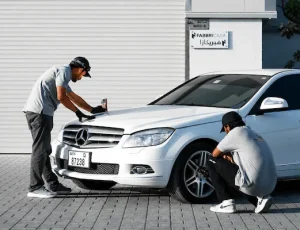
Also feel the gearbox. Hesitation, a thud into gear, or a flare in revs between shifts is one of the most expensive faults you can inherit — especially on European models. If you’re looking at a premium German car, a brand-specific check like a Mercedes inspection in Dubai picks up model-known weaknesses that a generic once-over won’t.
Step 9: What I Tell Buyers at the End
I don’t tell people “buy” or “don’t buy.” I give them three numbers:
- What’s wrong now
- What it will cost to put right
- What’s likely to go wrong in the next 12 months
That last number is what changes a negotiation. A buyer who can say “the discs are at the limit, the battery is 26 months old, and the front lower arms are worn — that’s AED 4,200” is negotiating with evidence, not opinion.
Sellers argue with feelings. They rarely argue with a photo report.
Why a Mobile Inspection Beats Driving to a Garage
The practical problem in Dubai is simple: most private sellers won’t hand their car over for a half-day trip across the city to a workshop.
That’s the whole reason mobile car inspection in Dubai exists. The inspector comes to the seller’s location — home, office, showroom parking — and does the full check there.
You keep the seller comfortable, you get a scanner, a paint gauge and a trained pair of eyes on the car, and you get a photo report the same day.
If you’re comparing providers, this guide on how to choose the right car inspection station in Dubai covers what to actually ask before booking.
Quick Checklist You Can Screenshot
| Area | Check | Red flag |
|---|---|---|
| Arrival | Bonnet cold | Engine pre-warmed |
| Papers | Chassis number matches Mulkiya | Bank finance outstanding |
| Body | Even panel gaps, consistent paint depth | One panel reading far higher |
| Heat | Battery date, dash cracks, roof clear coat | Battery over 2 years |
| Sand | Bumper sandblasting vs odometer | Low km, heavily pitted front end |
| Water | Seatbelt pulled fully out | Silt or tide line on webbing |
| Engine | Oil, coolant, leaks, cold start noise | Milky oil cap, rusty coolant |
| Scan | Readiness monitors, not just codes | Monitors “not ready” |
| AC | Parked, idling, in the sun | Cold at speed, warm at idle |
| Tyres | DOT date code | Older than 5 years |
| Drive | Bump, roundabout, hard brake, traffic | Clunks, clicks, pulsing pedal |
For the long-form version, see the full car inspection checklist and our complete UAE buyer’s checklist.
Frequently Asked Questions
How long should a proper pre-purchase inspection take?
A genuine check takes around 60 to 90 minutes including a diagnostic scan and a test drive. Anything finished in fifteen minutes is a visual glance, not an inspection.
Can I inspect the car myself instead?
You can catch a lot with the checks above, and you should do them. What you can’t do without equipment is measure paint depth, read module-level fault codes, or assess frame alignment — which is where the expensive faults hide. A used car inspection in Dubai covers those.
What if the seller refuses an inspection?
Walk away. A seller with nothing to hide has no reason to say no, and inspections don’t damage the car or delay a sale by more than an hour.
Is it worth inspecting a car still under warranty? Yes. Warranty covers component failure, not accident repairs, flood damage, worn tyres, brakes or bodywork — and those are exactly the items that shape the price you should be paying.
Can I get a report if I’m buying from another emirate or from abroad?
Yes — an online car inspection gets an inspector to the vehicle and delivers a photo report you can review remotely before committing.
The One Thing Worth Remembering
The SUV in Al Quoz had a cleared fault memory, a battery from 2021, and a repainted right rear quarter with a paint reading three times factory thickness.
It still looked perfect.
The buyer walked away and found a better car two weeks later. The inspection cost him a fraction of what the first car would have.
If you’re at the stage of agreeing a price on a used car, get eyes on it first. Read why in Don’t Buy a Used Car in Dubai Without a Full Car Inspection, or book a pre-purchase car inspection in Dubai and let the car tell you the truth before you pay for it.