A few months ago I was called out to a showroom in Al Quoz to inspect a five-year-old SUV. The buyer had already shaken hands on the price. He just wanted a report for peace of mind.
The car was beautiful. Fresh detailing, tyres with plenty of tread, service book stamped, not a scratch on the paint. On the test drive it felt tight. Nothing in the OBD scan.
Then I opened the bonnet and looked at the four bolts holding the right front fender in place.
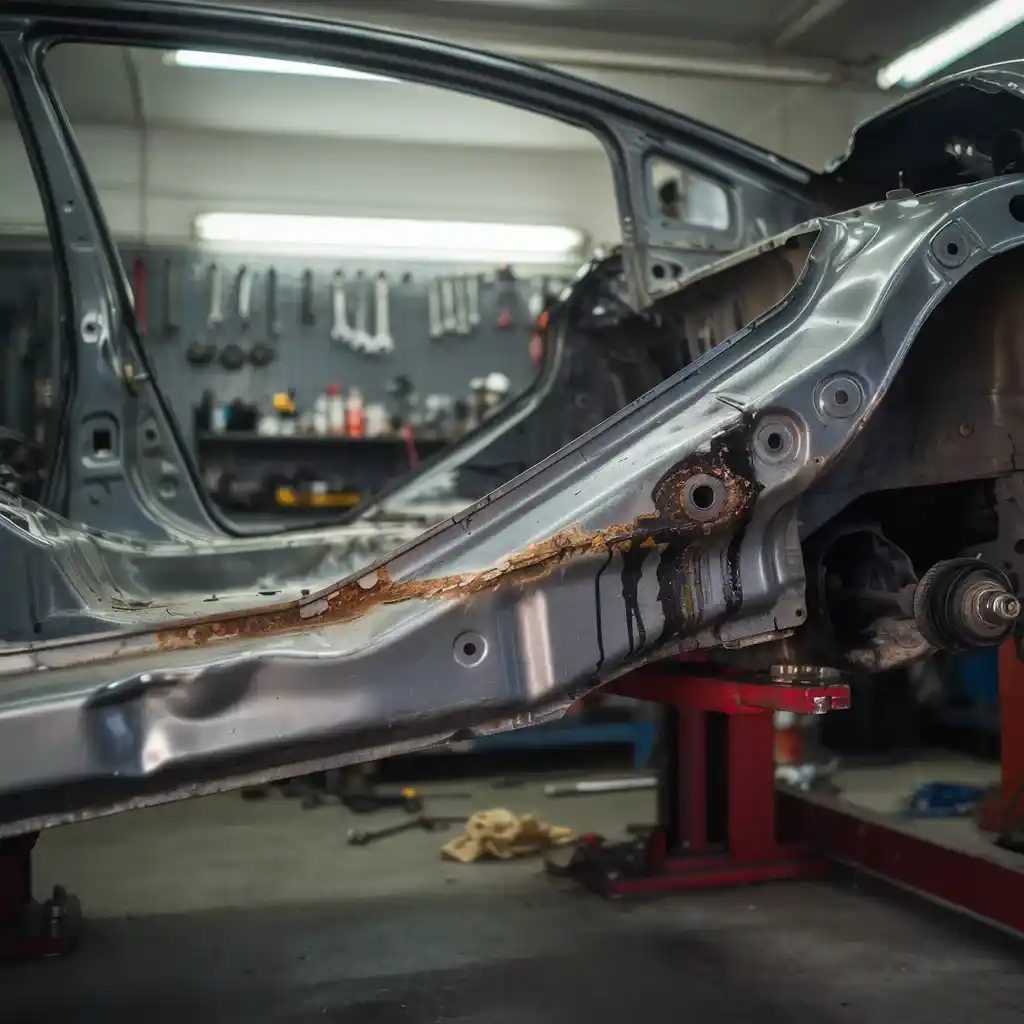
Three of them were untouched. The fourth had a small, silvery scar across the head, the kind a socket leaves when someone has cranked it loose. That one bolt changed the whole inspection. Twenty minutes later we had the car on a lift, and the right chassis rail had a soft ripple in it — the kind of wrinkle steel gets when it absorbs an impact and never fully goes back.
The buyer walked away. He’d been about to spend serious money on a car with structural damage that no amount of polishing could hide.
That’s what this article is about. Below are the nine things I check, in order, when I want to know the real condition of a car’s chassis — and what each one tells you.
First, what “chassis” actually means
In the UAE, people use the word “chassis” for two different things, and it causes confusion.
Sometimes it means the chassis number — the 17-character VIN stamped on your car. That’s an identity code, not a condition.
Here, we’re talking about the physical structure: the metal skeleton that everything else bolts onto. On older 4x4s and pickups it’s a separate ladder frame you can see under the car. On almost every modern sedan, hatchback and crossover it’s a unibody (or monocoque), where the frame and the body shell are one welded structure.
That difference matters. A ladder frame can sometimes be straightened. A damaged unibody is much harder to return to factory specification, because the crumple zones were engineered to deform in a very specific way — once. After a serious hit, they will never behave the same way again.
This is why structural damage is the single biggest red flag in any Mobile Pre Purchase car inspection in dubai. Engines can be rebuilt. Gearboxes can be replaced. A compromised chassis is a permanent condition.
9 signs of hidden frame damage
1. Panel gaps that don’t match side to side
Start here, because it’s free and takes ninety seconds.
Stand at the front of the car and look down the gap between the bonnet and each fender. Then do the doors, then the boot lid. Factory gaps are narrow, even, and identical on both sides.
Run your finger along the gap if you’re unsure — your hand notices a taper your eye misses. A gap that’s tight at the top and wide at the bottom, or noticeably different from the same gap on the other side, means panels have been removed and refitted. Sometimes that’s just a bumper repair. Sometimes it’s because the structure underneath moved.
Also check: does every door close with the same effort? A door that needs an extra shove, or that drops slightly as you swing it, is worth investigating.
2. Bolt heads with tool marks
This is the one that saved my client in Al Quoz.
Open the bonnet and look at the bolts holding the fenders, the bonnet hinges, and the front slam panel. From the factory, those bolts are torqued once by a machine and painted over. The paint on the bolt head should be unbroken and match the body colour or the factory primer.
Scratched, chipped, or shiny bolt heads mean the panel came off. On a car with no accident history, it shouldn’t have.
3. Ripples or wrinkles in the chassis rails
Now you need the car on a lift, or at least a torch and a bit of patience.
The two chassis rails run front to back, one on each side. They should be straight, smooth, and symmetrical. What you’re looking for is any wave, ripple, kink, or accordion-style buckling in the metal — especially just behind the front bumper mounts and around the suspension pickup points.
Steel that has absorbed a heavy impact usually shows it. Even after a repair, the tell is often a section that’s slightly flatter, slightly thicker, or slightly out of line with its twin on the other side. Compare left to right constantly. Symmetry is your best diagnostic tool.
4. Welds that don’t look like factory welds
Factory spot welds are a giveaway once you’ve seen a few. They appear as small, evenly spaced dimples in neat rows, all the same size, all the same distance apart. Robots made them.
Repair welds look completely different: continuous beads, uneven spacing, grinder marks, spatter, or a section that’s been ground smooth and repainted. Check the inner wings, the strut towers, the boot floor, and where the rear panel meets the quarter panels.
Any weld that doesn’t match the pattern on the opposite side of the car needs an explanation.
5. Seam sealer applied by hand
This is my favourite tell, because it’s very hard to fake.
Seam sealer is the flexible compound laid over joins in the metalwork to keep water out. Applied at the factory, it’s laid down by machine — consistent width, consistent texture, following the seam precisely.
Repair-shop sealer is applied with a gun and smoothed with a finger. It’s lumpy. It wanders. It’s often a slightly different colour or shine to the sealer three inches away.
Look in the engine bay, along the door sills, inside the boot under the carpet, and inside the wheel arches. Finger-smeared sealer means that seam was opened up.
6. Paint overspray where paint should never be
Open the doors and look at the rubber weather seals, the plastic trim inside the door jambs, and the bolts and hoses in the engine bay.
A factory paint job happens before most of those parts are fitted, so they stay clean. Bodyshop paint happens after, and even careful masking leaves a fine mist of colour on rubber, plastic, or the underside of the bonnet.
Overspray by itself only proves a repaint. But overspray inside the engine bay, in the door shuts, or in the boot well is different — those areas only get exposed when the structure is being worked on.
7. The car pulls, or the steering wheel sits off-centre
Find an empty, flat stretch of road. Get up to a steady speed and briefly relax your grip on the wheel.
A car with a straight structure tracks straight. If it drifts consistently to one side, or if you have to hold the wheel slightly rotated to drive in a straight line, something in the geometry is off. That can be a simple alignment issue. It can also be a chassis that is no longer square.
8. Uneven tyre wear that comes back after an alignment
This is the follow-up to sign 7, and it’s the more reliable of the two.
Look at the tread across the width of each tyre. Wear that’s heavy on one edge and light on the other means the wheel isn’t sitting at the correct angle.
Here’s the important part: a normal alignment fixes that. If the seller tells you the car “was just aligned” but the tyres are already wearing unevenly again, the alignment couldn’t be corrected — usually because the mounting points themselves have shifted. Ask for the alignment printout and look at the thrust angle and caster figures. Values that sit outside the manufacturer’s range, and can’t be brought back in, point to structural distortion.
9. Rust and fresh undercoating in the wrong places
Surface rust on an old exhaust bracket is normal. Rust at a weld seam is not.
Be especially suspicious of a car whose underside has been freshly sprayed with thick black undercoating. Sometimes that’s honest protection. Often it’s a cheap way to bury repair welds, filler, and corrosion under a layer that nobody wants to scrape at.
If the undercoating is new and the rest of the car isn’t, ask why.
The UAE-specific check: water damage
One more, and it’s local.
After heavy rainfall events in the Emirates, a number of water-damaged vehicles find their way back into the market — alongside imported salvage cars that arrive from overseas auctions with flood histories already attached.
Water attacks a chassis from the inside out. The places to look:
- Under the carpet, on the seat rails and floor bolts — these rust first
- The spare wheel well, where silt and a tide line collect
- Inside the door sills and behind trim panels
- Seatbelt webbing: pull it all the way out and check for a discolouration line
A flood car can look and drive perfectly for months before the corrosion and electrical faults surface. Verifying the car’s background matters as much as the physical check — our guide on how to check a car’s accident history in Dubai walks through the official channels for that.
What you can’t check yourself
Everything above is genuinely useful and costs you nothing but time. But there’s a limit, and it’s an honest one.
The nine signs tell you that a car probably has structural damage. They can’t tell you how much the structure has moved, or whether it’s still within factory tolerance.
That takes measurement. A proper Car Chassis Inspection compares dozens of reference points on the vehicle against the manufacturer’s original specification, on a lift, using laser or gauge measurement. It’s the difference between “this looks repaired” and “this rail sits eight millimetres out of position.”
That number is what actually matters, for three reasons:
- Safety. Crumple zones only protect you if they deform as designed.
- Value. Structural damage significantly reduces resale price, and the next buyer’s inspector will find it too.
- Insurance. A previously repaired structure can affect cover and claims.
Quick reference
| Sign | Where to look | What it suggests |
|---|---|---|
| Uneven panel gaps | Bonnet, doors, boot | Panels removed or structure shifted |
| Scratched bolt heads | Fenders, bonnet hinges | Panel disassembly |
| Rippled chassis rails | Under car, front and rear | Impact absorption |
| Non-factory welds | Strut towers, boot floor | Section replacement |
| Hand-applied seam sealer | Sills, engine bay, boot | Seam opened for repair |
| Overspray | Door jambs, rubber seals | Post-factory repaint |
| Pulling / off-centre wheel | Test drive | Geometry out of square |
| Uneven tyre wear | Tread across width | Alignment can’t hold |
| Rust at seams / fresh undercoat | Underbody | Corrosion or concealed repair |
Frequently asked questions
Can chassis damage be fully repaired?
A ladder-frame vehicle can often be straightened back into specification. A unibody is harder, because the crumple zones were engineered to deform once. A skilled shop can restore the measurements; restoring the original crash behaviour is a different question.
Does chassis damage always show on an accident history report?
No. Reports only capture incidents that were recorded — insurance claims, police reports, registered write-offs. A car repaired privately and paid for in cash leaves no trail. This is exactly why a physical inspection and a history check work best together, not as alternatives.
Is a bent chassis dangerous to drive?
It depends on severity and location. Minor distortion may cause nothing worse than tyre wear. Damage near suspension mounting points or crumple zones affects both handling and crash protection.
How long does a chassis inspection take?
A focused structural check typically takes 30 to 45 minutes. It’s usually done as part of a full pre-purchase inspection rather than on its own.
Before you sign anything
Nine times out of ten, the cars I inspect are fine. The point of checking isn’t paranoia — it’s that the one time it isn’t fine, you find out before the money moves, not after.
Walk the panel gaps. Check the bolts. Look at the welds. And if anything on that list makes you pause, get the car measured properly before you commit.
Top Wheels Performance carries out mobile car inspections at the seller’s location across all 7 Emirates, with a full report delivered the same day.